4. Open Response Assessments for Students
You may want to let your students know what to expect when they complete open response assessments. This guide walks students through each step of the process.
4.1. Student Introduction to Open Response Asssessments
In an open response assessment, you’ll provide a response to a question that may not have a simple or definitive answer. Some open response assessments have asked students to submit written responses, videos of speeches, and computer code.
Open response assessments may include a peer assessment, a self assessment, or both. With a peer assessment, you’ll assess, or grade, responses that several of your peers have submitted, and several of your peers will assess your response. With a self assessment, you’ll assess your own response. To assess a response, you’ll compare the response to a rubric that the instructor provides.
A rubric is a list of expectations that a response should meet. Rubrics are made of criteria and options. Criteria describe characteristics that the response should have, such as topics the response should cover. The options for each of the criteria describe how well the response satisfies the criteria. In the following image, you can see a rubric with two criteria. Each of the criteria has several options.
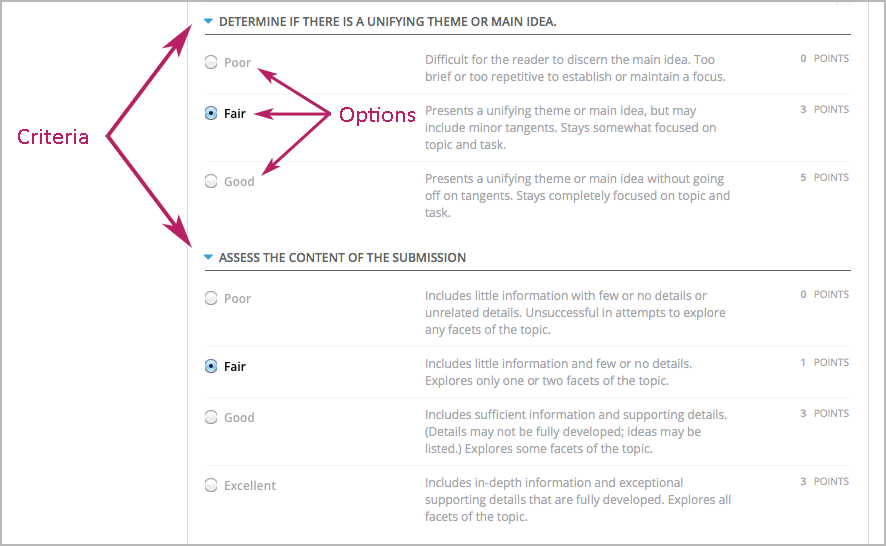
When you assess a response, you’ll select the option that best describes the response for each of the criteria.
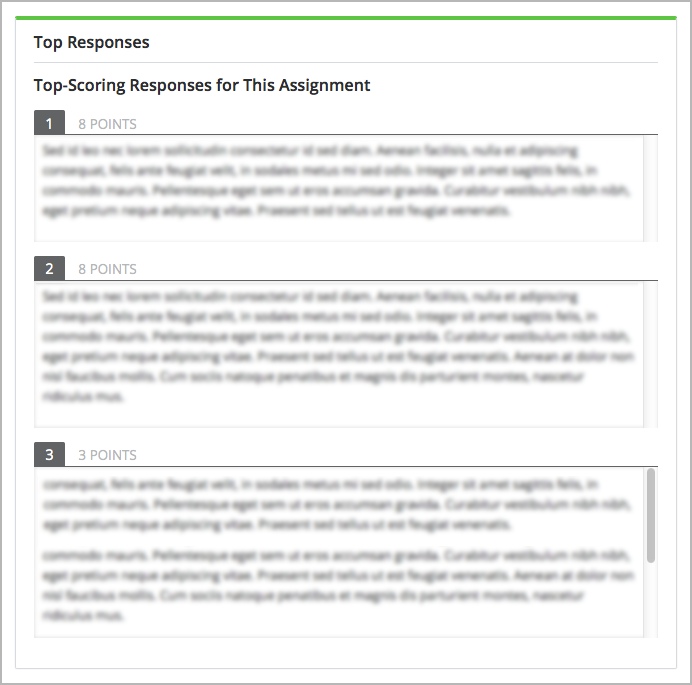
Some instructors create a Top Responses section that shows the top-scoring responses for the assignment and the scores that these responses received. If an instructor creates this section, you can see it below your score after you’ve completed each step of the assignment.
4.2. Student Instructions
When you come to an open response assessment in the course, you’ll see the question and a response field. After you submit your response, you’ll assess some of your peers’ responses, your own response, or both, depending on the assignment. You can see the steps that your assignment includes below the response field.
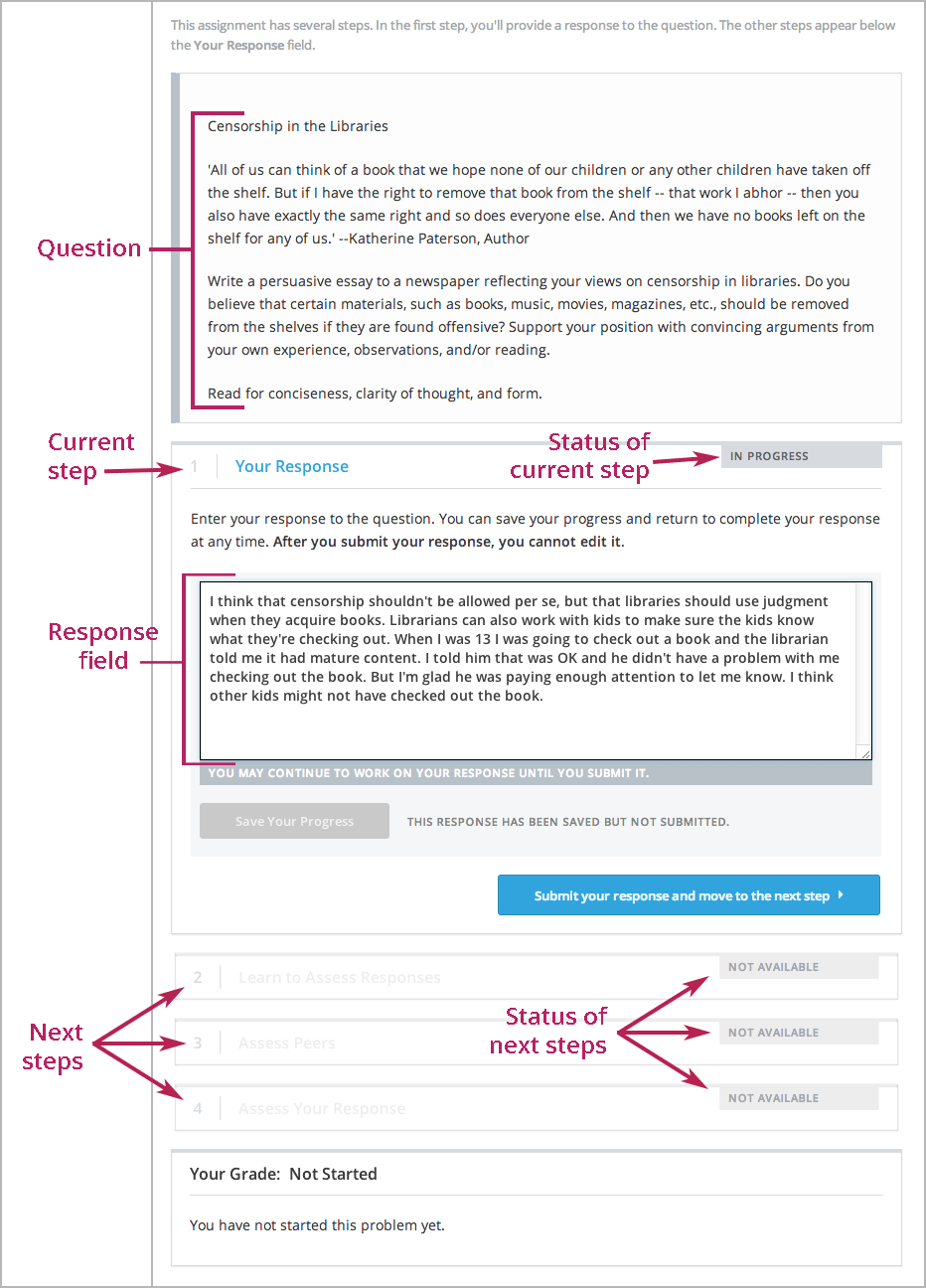
Here, we’ll walk you through the process of completing an open response assessment that includes a student training step, a peer assessment, and a self assessment:
- Submit your response to a question.
- Learn to assess responses.
- Assess responses that other students have submitted.
- Assess your own response to the question.
- Receive your score and provide feedback on the peer assessment.
At any time during the assessment, you can see your status at the bottom of the page under Your Grade. A message tells you the steps that you still have to perform before you can receive your grade. For example, you may see the following message:
Not Completed
You have not completed the peer assessment step and self assessment step of this problem.
4.2.1. Submit Your Response
Read the question carefully. Some instructors include important information in the question, such as how long your response must be or specific topics your response must cover.
註解
Your response must contain fewer than 10,000 words (approximately the equivalent of 20 pages of 8.5x11 paper, with text single-spaced).
After you compose a response, type it into the response field under Your Response, and then click Submit your response and move to the next step. If you can’t finish your response all at once, you can click Save Your Progress to save a draft of your response, and then come back and submit it later.
After you submit your response, if other students have already submitted responses, the peer assessment step starts immediately. However, you don’t have to start grading right away. If you want to stop working and come back later, just refresh or reopen your browser when you come back. New peer responses will be available for you to grade.
If no other students have submitted responses yet, you’ll see the following message:
Waiting for Peer Responses
All submitted peer responses have been assessed. Check back later to see if more students
have submitted responses. You'll receive your grade after you complete the peer assessment
and self assessment steps, and after your peers have assessed your response.
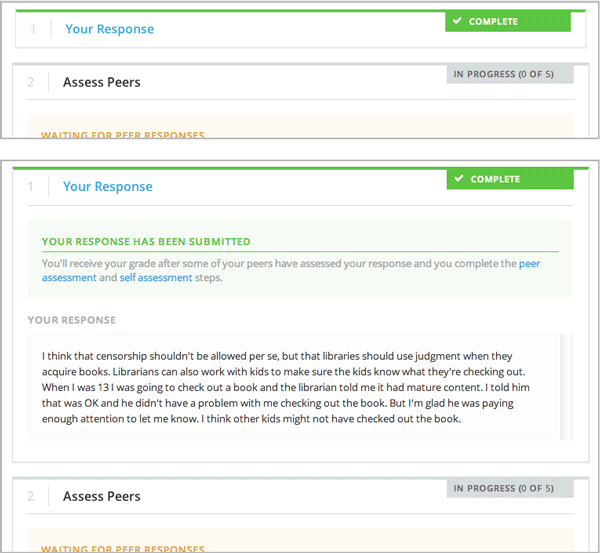
Note that you can view your response at any time after you submit it. To do this, click the Your Response heading to expand the response field.
4.2.1.1. Submit an Image with Your Response
Some assignments allow you to submit an image with your text response. If you can submit an image, you’ll see buttons that you’ll use to upload your image.
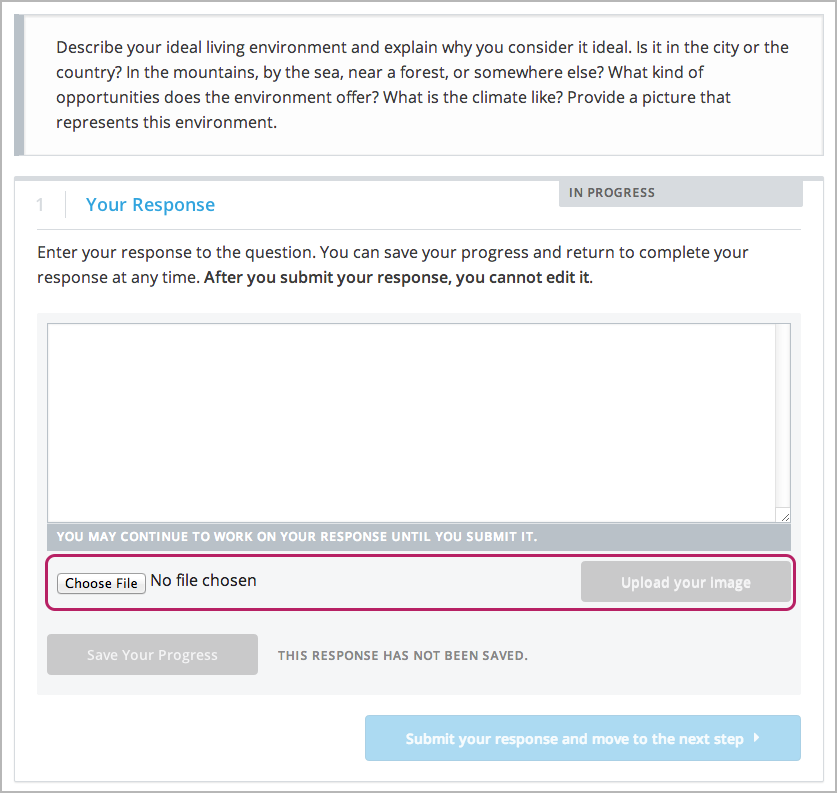
To upload your image:
- Click Choose File.
- In the dialog box that opens, select the file that you want, and then click Open.
- When the dialog box closes, click Upload Your Image.
註解
The image file must be a .jpg or .png file, and it must be smaller than 5 MB in size.
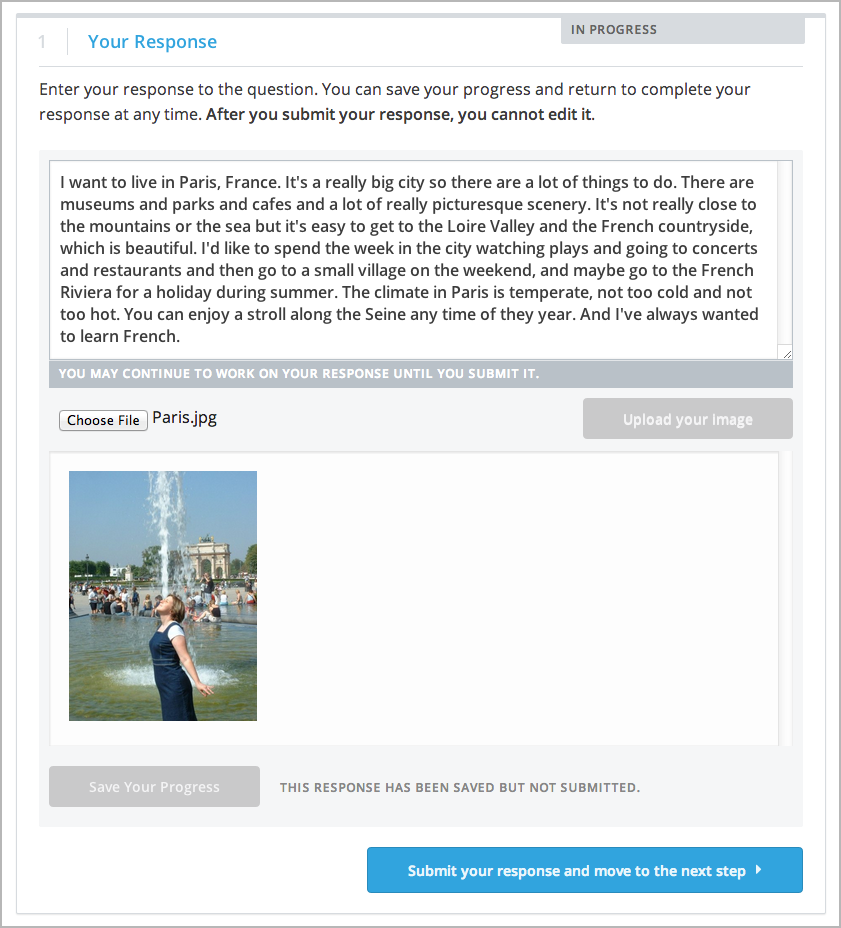
Your image appears below the response field, and the name of the image file appears next to the Choose File button. If you want to change the image, follow steps 1-3 again. You can only upload one image.
註解
You must submit text as well as your image in your response. You can’t submit a response that doesn’t contain text.
4.2.2. Learn to Assess Responses
In this step, you’ll learn to assess responses effectively by reviewing and assessing sample responses that the instructor has provided. You’ll try to select the same options for the response that the instructor selected.
註解
Not all instructors provide sample responses for training. If the instructor doesn’t provide sample responses, this step won’t appear in the assignment.
After you submit your response, one of the sample responses opens, together with the rubric for the assignment. Read the sample response and the rubric carefully, select the options that you think best reflect the response, and then click Compare your selections with the instructor’s selections.
If all of your selections match the instructor’s selections, the next sample response opens automatically.
If any your selections doesn’t match the instructor’s selections, you’ll see the response again, and the following message appears above the response:
Learning to Assess Responses
Your assessment differs from the instructor's assessment of this response. Review the
response and consider why the instructor may have assessed it differently. Then, try
the assessment again.
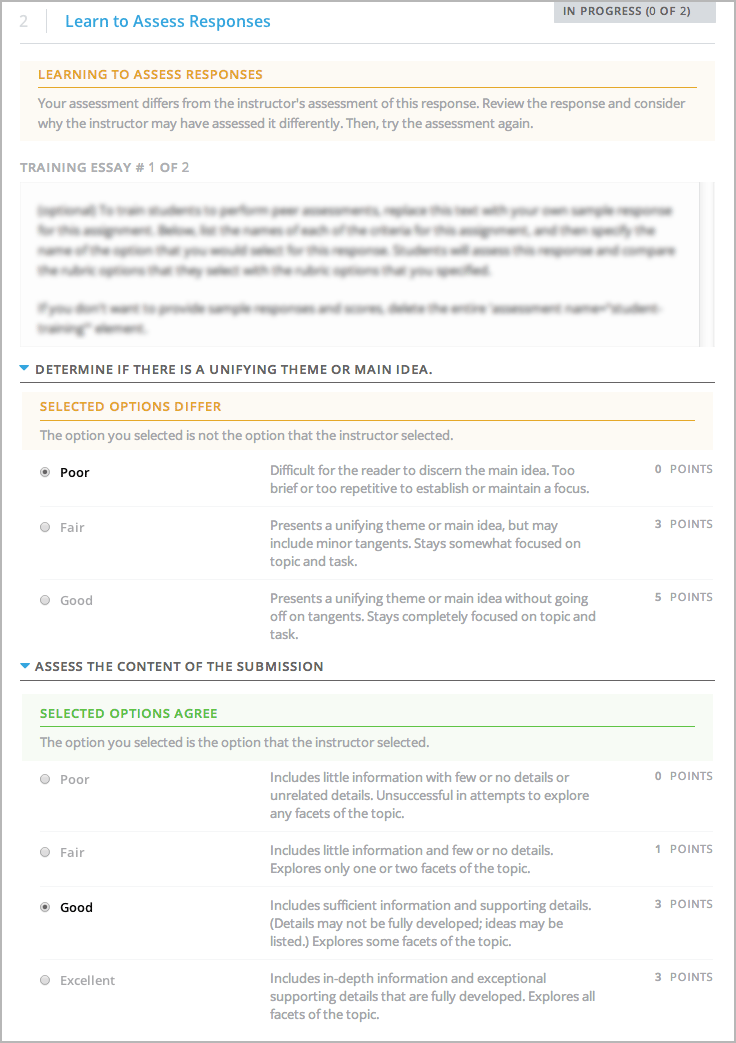
For each of the criteria, you’ll see one of the following two messages, depending on whether your selections matched those of the instructor:
Selected Options Differ
The option you selected is not the option that the instructor selected.
Selected Options Agree
The option you selected is the option that the instructor selected.
In the following example, the student chose one correct option and one incorrect option.
You’ll continue to assess the sample response until the options you select for all criteria match the options the instructor selected.
When you’ve successfully assessed all of the sample responses, you’ll move to the next step in the assignment.
4.2.3. Assess Peer Responses
When peer assessment starts, you’ll see the original question, another student’s response, and the rubric for the assignment. Above the response you can see how many responses you’ll assess and how many you’ve already assessed.
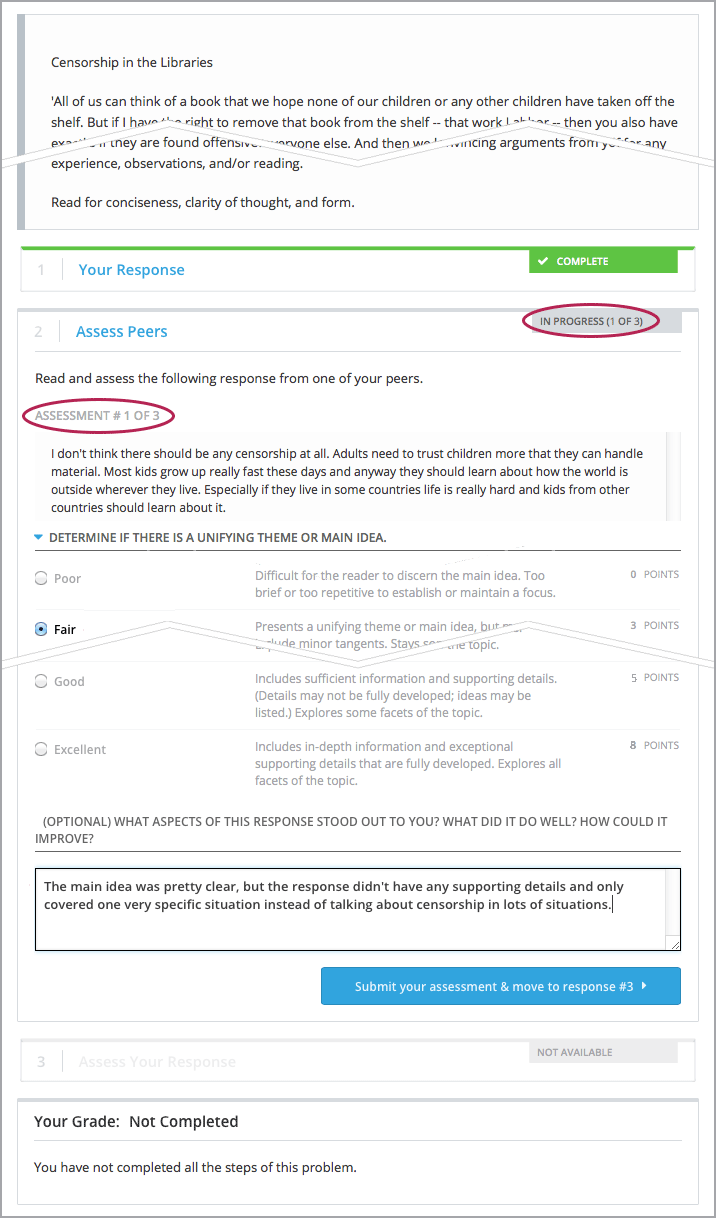
You’ll assess these responses by selecting options in the rubric, the same way you assessed the sample responses in the “learn to assess responses” step. Additionally, this step has a field below the rubric where you can provide comments about the student’s response.
註解
Some assessments may have an additional Comments field for one or more of the assessment’s individual criteria. You can enter up to 300 characters in these fields. In the following image, both criteria have a Comments field. There is also a field for overall comments on the response.
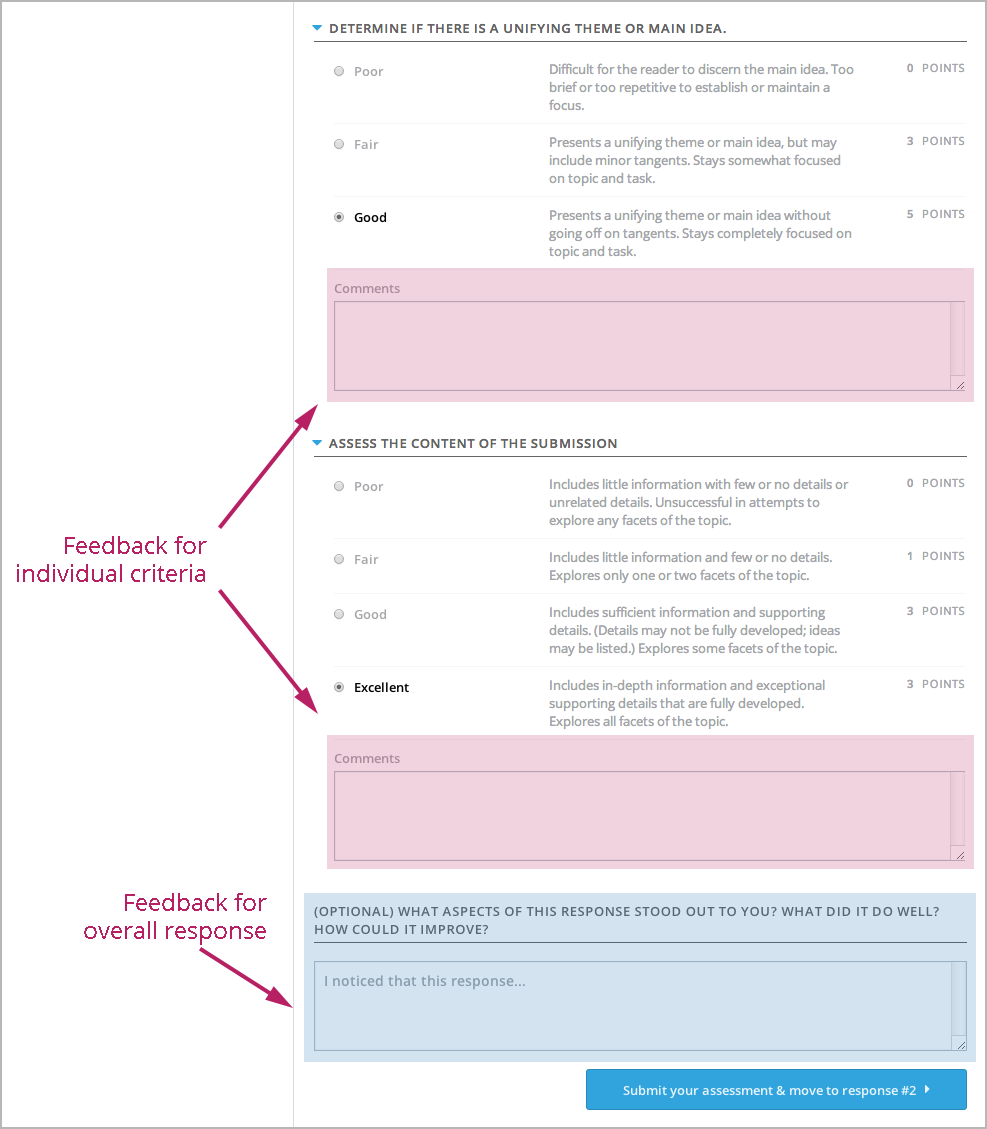
After you’ve selected options in the rubric and provided additional comments about the response in this field, click Submit your assessment and move to response #<number>.
When you submit your assessment of the first student’s response, another response opens for you. Assess this response in the same way that you assessed the first response, and then submit your assessment. You’ll repeat these steps until you’ve assessed the required number of responses. The number in the upper-right corner of the step is updated as you assess each response.
4.2.3.1. Assess Additional Peer Responses
You can assess more peer responses if you want to. After you assess the required number of responses, the step “collapses” so that just the Assess Peers heading is visible.
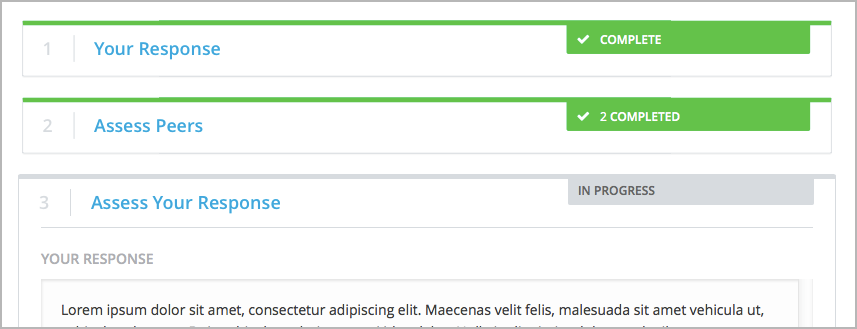
To assess more responses, click the Assess Peers heading to expand the step. Then, click Continue Assessing Peers.
4.2.4. Assess Your Response
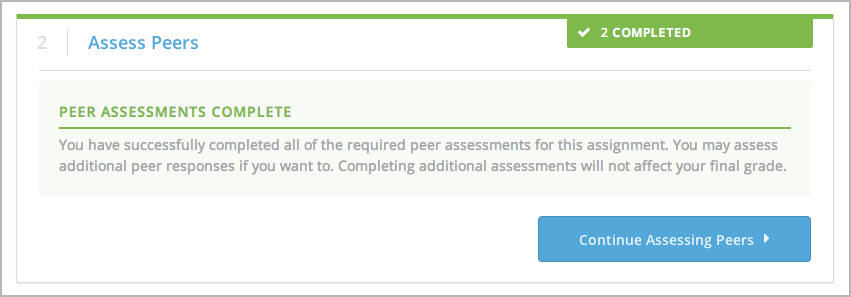
When you’ve completed enough peer assessments, your self assessment opens. You’ll see your response along with the same rubric that you used in the peer assessment step. Assess your response, and then click Submit Your Assessment.
4.2.5. Receive Your Score and Provide Feedback
After you submit your self assessment, if other students are still assessing your response, you’ll see the following message under the Assess Your Response step.
Your Grade: Waiting for Peer Assessment

Your response is still undergoing peer assessment. After your peers have assessed your
response, you'll see their feedback and receive your final grade.
If you see this message, keep checking back periodically until peer assessment is complete.
When peer assessment is complete, you can see the scores you received from all of your peers, as well as your self assessment. You can also see any additional comments that your peers have provided.
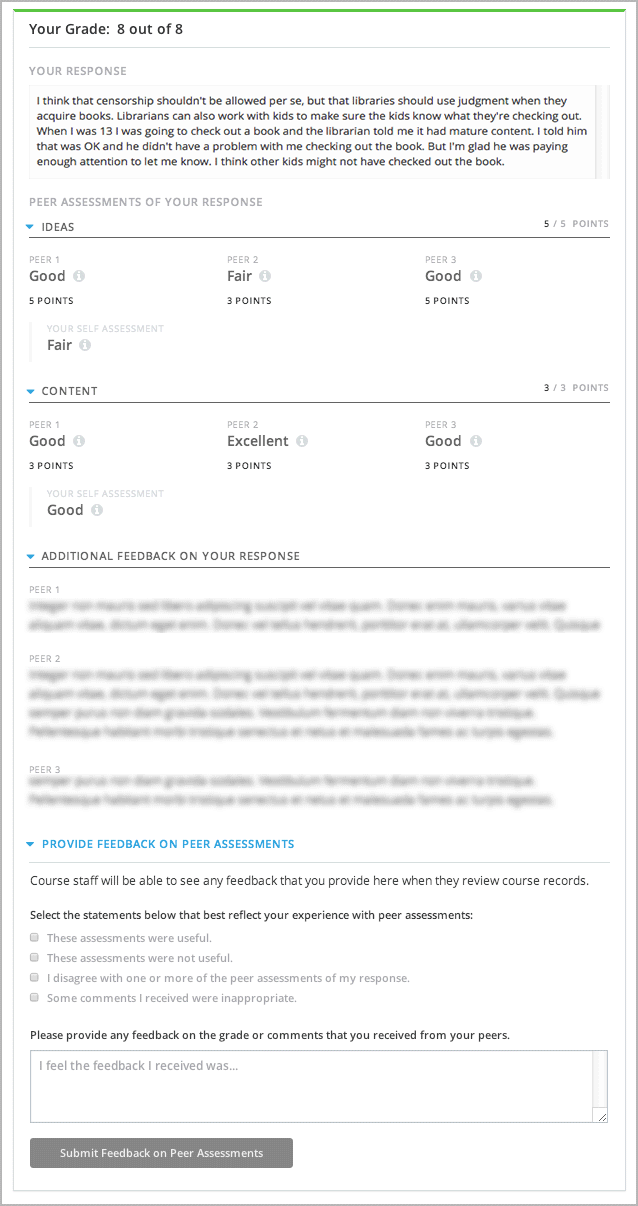
If you want to, you can provide feedback on the scores that you received under Provide Feedback on Peer Assessments.
4.2.6. Assess Additional Peer Responses (optional)
If you’ve assessed the required number of peer responses and completed your self assessment, you can assess additional peer responses. To do this, click the Assess Peers heading. If any responses remain to be assessed, a new response opens.
4.3. Peer Assessment Scoring
Peer assessments are scored by criteria. An individual criterion’s score is the median, not average, of the scores that each peer assessor gave that criterion. For example, if the Ideas criterion in a peer assessment receives a 10 from one student, a 7 from a second student, and an 8 from a third student, the Ideas criterion’s score is 8.
Your final score for a peer assessment is the sum of the median scores for each individual criterion.
For example, a response may receive the following scores from peer assessors:
| Criterion Name | Peer 1 | Peer 2 | Peer 3 | Median |
|---|---|---|---|---|
| Ideas (out of 10) | 10 | 7 | 8 | 8 |
| Content (out of 10) | 7 | 9 | 8 | 8 |
| Grammar (out of 5) | 4 | 4 | 5 | 4 |
To calculate the final score, the system adds the median scores for each criterion:
Ideas median (8/10) + Content median (8/10) + Grammar median (4/5) = final score (20/25)
Note, again, that final scores are calculated by criteria, not by assessor. Thus your score is not the median of the scores that each individual peer assessor gave the response.
4.3.1. View Top Responses (optional)
If the instructor has included a Top Responses section, you can see the highest-scoring responses that your peers have submitted. This section only appears after you’ve completed all the steps of the assignment.